
Carbon Accounting Software Cost: Build a Budget You Can Actually Compare
Original synthetic editorial photograph. Evidence documents and a laptop establish an attentive budget-review scene without fake readable numbers. Spatial grouping, branches, proportions or directional paths carry the claim with concise labels.
Diagram text description
A sustainability manager asks three vendors for a carbon accounting platform. One responds with a published annual fee. Another quotes a price after a discovery call. A third offers a low entry tier but excludes the supplier-data workflow the company actually needs. The numbers are not yet comparable. The useful question behind carbon accounting software cost is what the company must pay to produce, review and reuse the inventory it needs—not what the cheapest number on a pricing page says.
There is no defensible single market price for every organization. A one-entity Scope 1 and 2 inventory, a multi-country Scope 3 programme and product-level supplier evidence impose different work. Public vendor pages confirm this variety: CarbonTool displayed named euro-denominated tiers when checked in October 2026, while Normative’s pricing page asked for a personalized quote. Neither page establishes a typical market rate.
Start with a written scope before asking for a price. Define entities, reporting years, categories, contributors, supplier records, required outputs, integrations and review controls. Then compare the first-year cost, renewal cost and internal effort under the same assumptions. The worked budget below makes those differences visible, including a case where the apparently cheaper subscription costs more in the first year.
The short answer: cost depends on inventory scope
The short answer is that the price of carbon accounting software depends on the inventory and service being bought. A vendor may charge by organization, entity, project, reporting module, support level or a negotiated package. A public annual subscription may omit onboarding and unusual data work; a private quote may bundle them. Even identical subscription totals can buy different reporting boundaries.
Table 1: scroll horizontally if needed.
| Buying situation | What the headline price may cover | What the buyer still needs to verify |
|---|---|---|
| Single-entity basic inventory | A defined plan and standard data entry | Scope categories, reporting years, factor updates, review and exports |
| Multiple entities or business units | Consolidation and additional workspaces | Entity limits, local factors, access rights, intercompany adjustments |
| Supplier-heavy Scope 3 work | Collection or supply-chain modules | Supplier count, reminders, evidence status, estimates, quality review |
| Product/customer proof | Product records or specialized outputs | Product boundaries, versioning, supplier linkage and reusable evidence |
| Quote-based enterprise package | Negotiated license and possible services | Setup hours, implementation milestones, overages, renewal and exit |
The boundary contains distinct requirements, not equal cost shares. A multi-entity supplier programme cannot be priced by assuming that a single-entity entry plan includes its consolidation, permissions and evidence workflow.
Diagram text description
This is a comparison of possible contract shapes, not a price list. The CarbonTool public page checked on 29 October 2026 listed Core at €2,000 per year for a single entity, Pro at €5,000 and Enterprise at €7,500, each with different stated scope and support. Those are that vendor’s published terms on that date, in euros, not a survey average or a promise that another buyer will receive the same terms. A quote-only vendor must instead supply a written, dated proposal. Both routes still require the buyer to validate what the figures exclude.
What a quoted software price does and does not include
A software proposal should be separated into stages before anyone signs it. The division makes later overages visible and prevents an implementation fee from disappearing into a seemingly cheap annual price.
- Define the license. Record the product edition, reporting entities, users, years retained, Scope 1, 2 and 3 coverage, business units, projects and output formats. Ask which limits reset and which are lifetime caps. “Full platform” is not a contract specification.
- Price deployment. Request separate line items for configuration, boundary setup, historical-data import, factor mapping, training and a parallel run. A self-service plan may omit expert support; a managed package may include some of it. Ask who performs each task.
- Price ongoing work. Check supplier invitations, data storage, API calls, integrations, additional sources, support hours, report templates, factor updates and verification preparation. Some may be included, metered or explicitly unavailable.
- Price change and exit. Ask what happens when an entity is acquired, a category is added, a prior year is restated or the contract ends. Confirm export formats and whether source files, approvals, factor identifiers and calculation history can be retrieved without an extra fee.
These are evaluation line items, not a claim that every vendor charges for each one. For example, the CarbonTool page states unlimited users and no per-seat fee, but lists optional onboarding, expert consulting and certain add-ons. A different vendor might bundle those services or price them differently. Do not infer the inclusion of assurance from a report-generation feature. Independent assurance and a software subscription answer different questions.
Make the proposal state which amounts are recurring, one-off or usage-based. Require taxes, currency, billing interval, discount conditions and renewal notice periods to be explicit. A low introductory number is not the cost of operating the workflow for several reporting cycles.
Why two carbon software quotes are not directly comparable
Two quotes are comparable only when they describe the same inventory job. Imagine one platform priced for a single entity and one reporting year while the other covers six subsidiaries, three historical years and supplier questionnaires. The latter may be more expensive but the difference cannot be read as a software premium until the scopes match. Conversely, an enterprise quote may include modules the company does not need.
Prepare one “reference inventory” and send it unchanged to every vendor. It should name the legal entities and countries, financial and reporting years, operational-control or other boundary choice, relevant Scope 1 and 2 sources, material Scope 3 categories, number and type of source records, known estimates and factor-version requirements. State the number of contributors, approvers and readers. Include the outputs: management dashboard, corporate inventory, customer questionnaire, product-level data or assurance pack as applicable.
The fork distributes one reference inventory and the same five exceptions. It does not declare equivalence merely because both vendors respond; scope, demonstrated outcomes and remaining work still need comparison.
Diagram text description
Then add five real exceptions. A corrected fuel invoice, an electricity bill crossing periods, a supplier response in an unexpected unit, a changed factor and a prior-year recalculation reveal what the price buys. Ask each vendor to show whether those cases can be processed, who approves them, and whether the original and revised evidence remain visible. A quote that simply says “Scope 3 included” may not include the collection and review work needed to make Category 1 material data usable.
The GHG Protocol Corporate and Scope 3 Standards define accounting and reporting disciplines independently of vendor packages. Therefore the buyer should test the proposed workflow against its reporting requirements instead of assuming an expensive package is methodologically correct. The price comparison follows the evidence requirement, not the other way around.
How to read public prices and quote-only pages
Public prices are useful anchors, but they are easily misread. A page may show a monthly equivalent billed annually, a per-entity limit, a trial period, a region-specific currency or a feature available only on request. A ranking article may repeat a number from an older vendor page. A quote page may not publish any number at all.
- Capture the live offer. Save the date, currency, billing interval, tier, entity and project limits, support hours and the exact wording around add-ons. Check the vendor page rather than a search-result snippet. Public terms can change after this article is written.
- Identify the comparison unit. Convert only after recording whether the offer is per year, month, site or organization, and whether tax and onboarding are excluded. Do not treat a free trial as a free continuing inventory.
- Mark unknowns. If a vendor says “get a personalized quote,” enter “not published” rather than copying a third-party estimate. Obtain the actual offer in writing with validity date and assumptions.
- Do not average unlike offers. A simple listed tier and a negotiated full-service programme are different products. An average of their headline figures would conceal scope, service and regional differences.
CarbonTool’s dated public tier page is an example of a published plan; Normative’s observed pricing page is an example of a personal-quote route. Neither is endorsed here. The reviewed commercial articles showed broad claimed ranges, but their ranges were not an independently sampled, like-for-like market study. This is why the buyer should use a quote-normalization worksheet rather than a supposed universal price benchmark.
At contract review, request written clarification of features that appear only in marketing language. A “verification-ready” export may be useful but does not mean an independent verifier has checked the inventory. A claimed integration may require an additional connector or implementation work.
Build a first-year budget and a separate operating-year budget
Treat the first year as a project plus an operating service. Setup, migration and initial training are not the same cost as the recurring license. A renewal budget should reflect the work that actually continues, including support, integration maintenance and internal review. Keep supplier payments separate from staff time before combining them into a wider resource estimate.
Consider two fictional offers for the same reporting boundary. In an invented currency called budget dollars, Offer A charges 8,000 for the annual license and 3,000 for setup. Offer B charges 11,000 for the license and 1,000 for setup. A pilot estimates 120 internal hours for A and 60 for B. At an assumed fully loaded planning rate of 50 budget dollars per hour, internal effort is 6,000 for A and 3,000 for B. None of these numbers is a vendor price or a market benchmark.
Table 2: scroll horizontally if needed.
| First-year component | Offer A | Offer B |
|---|---|---|
| Annual license | 8,000 | 11,000 |
| One-off setup | 3,000 | 1,000 |
| Supplier cash subtotal | 11,000 | 12,000 |
| Internal effort at assumed rate | 6,000 | 3,000 |
| Wider resource total | 17,000 | 15,000 |
All amounts are fictional budget dollars. Offer A supplier cash is 8,000 license plus 3,000 setup. Its assumed internal effort is 120 hours times 50 per hour, or 6,000, producing 17,000. Staff time is not automatically a cash saving.
Diagram text description
The license-only comparison favours A by 3,000. The wider first-year estimate favours B by 2,000 because of the assumed effort difference. Finance may still distinguish cash affordability from the value of existing staff time: a released hour does not automatically reduce payroll. Show both totals so the decision does not depend on hiding one perspective.
Now change the period. Suppose both licenses remain unchanged, setup does not recur, and expected internal operating effort is 40 hours for A and 30 for B. At the same planning rate, the next-year resource totals are 10,000 and 12,500. Across these two undiscounted years, A totals 27,000 and B 27,500. The first-year ranking reverses over this particular horizon. That does not establish a winner because service quality, growth and the reliability of the hour estimates still matter.
The fictional resource totals use unchanged licenses, no repeated setup and 40 versus 30 internal hours in year two. Totals are undiscounted budget dollars. A and B are separate alternatives, not amounts to combine with each other.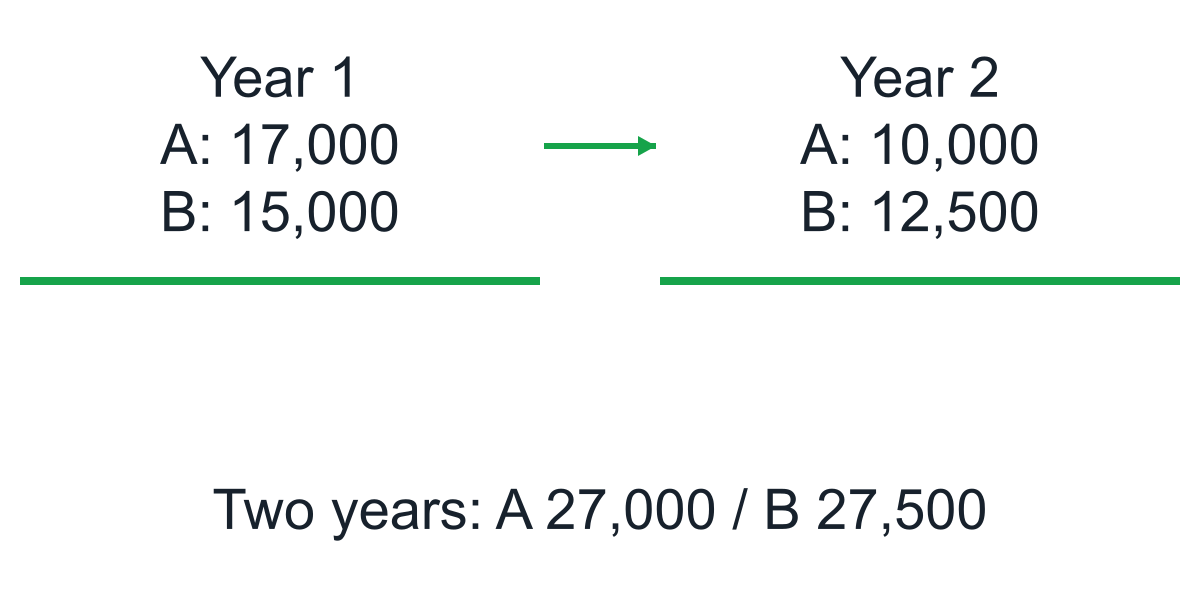
Diagram text description
The calculation is ordinary scenario budgeting: add compatible costs once, in the same currency and period, and price hours separately. It is not a prescribed procurement formula or an ROI forecast. Taxes, financing, exchange movements, overages and exit costs are excluded from this simplified example. A real budget must add material items using its own accounting treatment rather than copy these exclusions.
Test uncertain assumptions directly. If A's first-year effort were only 80 hours, its resource total would be 15,000, equal to B's assumed total. That break-even follows from 11,000 + 50 × hours = 15,000. It tells the buyer which estimate deserves a better pilot measurement; it does not prove the team can achieve 80 hours. Ask staff to log representative import, correction and review tasks before treating the estimate as a saving.
This author-constructed budget sensitivity solves 11,000 + 50 × hours = 15,000, giving 80 hours. It does not establish that 80 hours is achievable or that the alternatives offer equal service.
Diagram text description
The hidden work that can outweigh the license
The license is often only the visible cost. A company might have several years of bills in different units, spreadsheet versions without named owners and supplier answers that use incompatible product boundaries. No purchased platform can automatically decide which source is valid, which factor period applies or whether a supplier number is a measured product footprint. People must define, clean and approve these decisions.
That work can be substantial even when the product subscription is modest. Ask who will identify missing data, map historical categories, reconcile totals, train site owners and handle rejected inputs. A data import that completes technically is not a validated inventory. Sample the imported records back to original invoices, factors and reviewer decisions. A late correction should show what changed in the current and comparative outputs.
Scope 3 can make the cost picture more complex. A plan may advertise all categories but offer only basic calculations, while supplier outreach, primary-data review or product-level evidence needs separate configuration. The GHG Protocol’s Scope 3 Standard requires attention to category boundaries, data quality and transparent methods; a feature label cannot substitute for that analysis. Price the exact workflow rather than the word “included.”
Also price the effort of staying with the present process. If the team spends weeks reconstructing sources for each customer request, record the time and failure mode. If a controlled workbook produces an auditable result quickly, do not invent savings simply to justify a subscription. Compare a documented operational problem against a demonstrated solution. Internal effort matters, but it must be measured rather than guessed.
Measure the baseline with the same care. If a spreadsheet cycle takes 100 hours and a pilot takes 70, examine whether both include the same reconciliations, supplier follow-ups and final review. A demonstration prepared by the vendor may omit the work of extracting records from your systems. Conversely, an initial learning period may overstate steady-state operating effort. Separate one-time learning, repeatable tasks and unresolved exceptions before projecting several years of savings.
Make vendor answers testable
Give each vendor the same reference inventory and ask for a written response that links a requirement to a demonstrated workflow and a priced line. The answer should distinguish included capability, separately priced work, a controlled manual step and something unavailable. A roadmap item belongs in a separate column; its expected delivery date is not present functionality.
For a supplier-heavy example, request a demonstration with ten representative supplier responses, including a missing unit, a duplicated submission and a corrected product figure. Ask how contributors are invited, how exceptions are resolved and which staff must hold paid access. Then request the price at the expected supplier volume. A successful ten-record demonstration establishes a narrow capability; it does not prove acceptable cost or performance at ten thousand records.
Ten responses can reveal handling of missing units, duplicates and corrections. They do not by themselves establish performance or cost at the buyer’s full volume. There is deliberately no automatic scaling arrow.
Diagram text description
For a multi-entity buyer, use two subsidiaries and a shared service as the test boundary. Ask how the platform consolidates without counting the shared activity twice, restricts each contributor's access and preserves local factor choices. Confirm whether an additional entity changes the subscription, implementation scope or both. These questions turn a feature label into a specific purchase requirement.
Table 3: scroll horizontally if needed.
| Requirement | Demonstration | Commercial clarification |
|---|---|---|
| Historical correction | Replace one invoice and inspect affected outputs | Is restatement support included? |
| Supplier evidence | Resolve an unexpected unit without losing the source | Which volume and contributor limits apply? |
| Review access | Let a reviewer trace one result | Is a separate paid seat required? |
| Data exit | Open exported records outside the product | Which files, identifiers and history are included? |
Include the factor source, period and version in the calculation demonstration. Ask whether approval belongs to the customer's reviewer, a vendor service or an external assurance provider. Those are different responsibilities. A generated report does not establish that an independent assessor has accepted the underlying inventory.
Finally, reconcile the response with the contract: minimum term, currency, tax treatment, billing interval, support allowance, usage charges, renewal changes, notice dates and termination help. If the demonstration and proposal disagree, resolve the specific requirement in writing. The comparison should leave finance and sustainability discussing the same service, not two interpretations of a sales presentation.
When a lower-priced tier is the wrong bargain
A cheaper tier is the wrong bargain when it omits a necessary control and the omission cannot be solved safely elsewhere. A company with several subsidiaries may need consolidation and different permissions, not merely a higher data-point allowance. A supplier-heavy inventory may need evidence status and reviewer workflows, not only a Scope 3 total. A team preparing for assurance may need source-file retention, factor history and accessible explanations rather than a visually polished export.
This does not mean buying the most expensive tier. A plan with more modules can still be a poor fit if it cannot model the company’s boundary or export its data. Evaluate a lower-priced plan against the actual reference inventory. Mark each requirement as demonstrated, available with a separately priced add-on, manual but controlled, unavailable or not yet tested. A manual process can be acceptable when the owner and review step are explicit; an untested promise should not be treated as a pass.
The most serious false economy is paying for a number the business cannot explain. GHG Protocol principles concerning relevance, completeness, consistency, transparency and accuracy depend on evidence and method. A plan’s price does not prove those principles have been met. If the product cannot preserve the source and factor trail through a correction, the company may spend less on license fees but more on repeated reconciliation and disputes.
The sequence follows data leaving the product, not an approval workflow. Sources, factor identifiers and required history must remain interpretable outside the vendor environment; a download button alone does not prove that result.
Diagram text description
Test the exit path too. If the company must change vendor after two cycles, can it retrieve historical activity data, factor IDs, approvals and reports in usable formats? A low fee paired with an opaque export can create a later dependency. Ask for a sample export before the contract is signed.
Use the pilot to decide what the extra cost buys
A pilot should resolve the uncertainty that could change the purchase. In the worked budget, the internal-hour estimate changes the first-year ranking. Measure those hours on representative tasks. If export quality or supplier review is the essential requirement, inspect that output rather than spending the demonstration on a polished dashboard.
Use the same records and exceptions for each contender: a corrected invoice, an electricity period crossing the reporting year, an unusual supplier unit, a factor revision and an export for an outside reviewer. Preserve the observations from each run. A vendor can explain a failure and propose a remedy, but the remedy should be demonstrated or priced as remaining work before it becomes a pass.
Table 4: scroll horizontally if needed.
| Purchase decision | Evidence that changes it |
|---|---|
| Pay more for implementation | Measured reduction in internal setup work with the same completed scope |
| Buy a higher tier | A necessary control or volume is unavailable in the lower tier |
| Keep a simpler system | The existing process meets requirements at lower total burden |
| Delay selection | A material boundary, export or correction requirement remains unresolved |
The result need not be the platform with the most modules. A controlled manual step may be economical for a small recurring exception. A manual workaround repeated across thousands of supplier records may be the dominant cost. Specify its owner, frequency and expected effort so it is evaluated at the right scale.
Before signing, test one change the business plausibly expects: an acquisition, another reporting year, an additional supplier campaign or a customer request for product-level evidence. Ask how that change affects capacity and price. The purpose is not to buy every possible future feature; it is to avoid a foreseeable mismatch hidden by today's narrow demonstration.
Choose a cost horizon that matches the commitment
Use the written contract term and expected operating horizon when presenting the decision. A one-year cash limit, a two-year resource comparison and a longer-term technology decision can point in different directions. Explain that difference rather than selecting the horizon that makes the preferred vendor look cheapest.
For the fictional offers, B requires more supplier cash in year one but less total estimated resource. A is slightly lower across two undiscounted years under the stated renewal assumptions. A small change in effort can reverse that conclusion. The decision therefore rests on the credibility of the pilot and the value of the required service, not on the precision of the spreadsheet total.
Keep the dated proposal, normalized scope and measured exceptions with the purchase decision. At renewal, compare actual effort and usage with the original assumptions. If the software removes a demonstrated burden, that experience supports continued investment. If the burden merely moved to an unpriced manual process, the next negotiation has a specific problem to solve.
Company carbon accounting