
Carbon Offsetting
Your footprint.
Your choice of climate action.
Explore carbon-credit projects after calculating a product or order. Choose a project, review the purchase separately and keep the certificate evidence connected to your campaign.
Calculate first. Credits are optional and purchased separately.
Carbon Credit Centre
A choice beyond the calculation.
 Nature
 Energy & communities
 Purchase evidence
Explore 15+ carbon programs, compare the available project details and choose what fits your campaign.
One place to connect your calculated footprint with a separate carbon-credit purchase.
Follow the journey
From a known footprint to a documented purchase.
Keep the emissions result and the credit purchase clear at every stage. Explore the steps below to see what happens in the platform.
Your starting point
Start with the completed footprint.
Review the products, quantities and scope in your project. The calculation gives you the emissions result to refer to when considering a separate credit purchase.
Check the reported kg CO₂e and its equivalent in tonnes. The purchase workflow then lets you review the credit quantity and price before proceeding.
Walk through this with our team →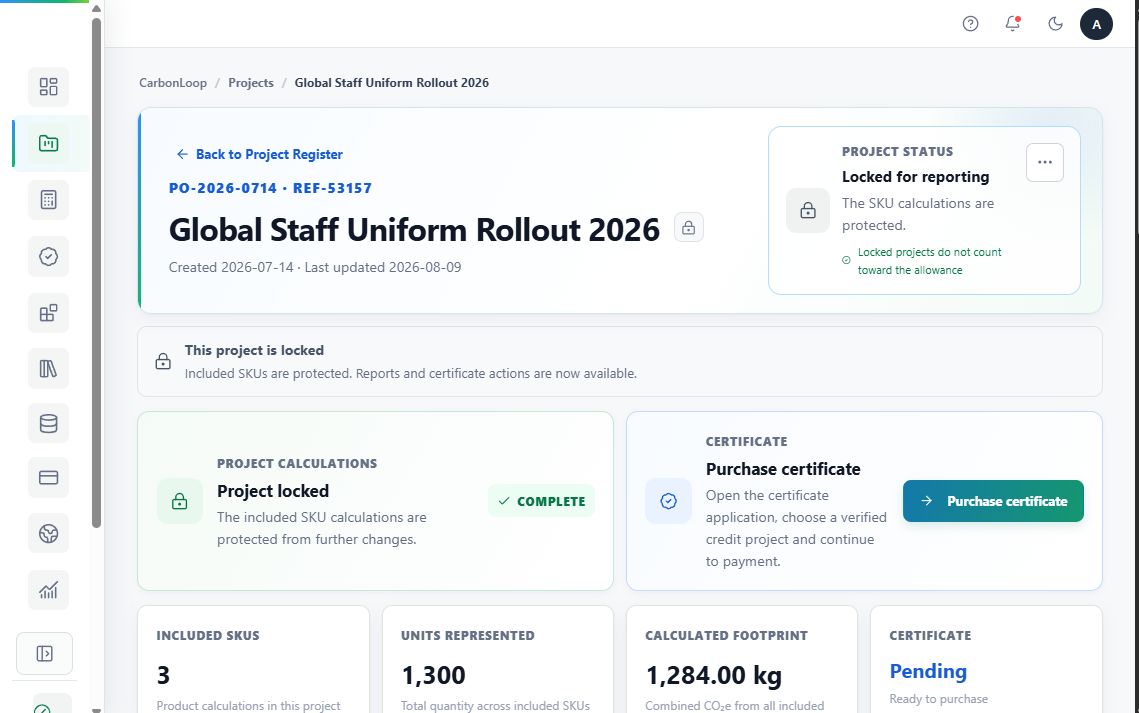
Explore the possibilities
Different projects. A more informed choice.
Explore the available program’s activity, location and supporting information. These are examples of project types; current availability and documented outcomes vary by project.

Forestry & nature
Explore forest restoration and land-based projects, including their carbon activity and any documented biodiversity contributions.

Blue carbon & coasts
Learn about coastal and mangrove projects, the ecosystems involved and the evidence supporting each project’s outcomes.


Energy & communities
Compare energy and community-focused programs through their stated activities, credit details and documented wider contributions.
Water, biodiversity, carbon removal and clean technology may also feature in available programs. Check the individual listing for the activity and evidence behind it.
Look beyond the project name
See what you’re choosing before you buy.
Use the project listing and its supporting information to understand the credit on offer. Compare the details relevant to your campaign rather than relying on a category alone.
- Project & location
- The activity, country or region and the project identity.
- Standard & evidence
- The stated carbon standard, verification information and supporting records available for that listing.
- Quantity & price
- The credit quantity, unit price and total shown for your purchase.
Look closer.
Choose with confidence.
Then follow the details behind it.
What it does. Where it operates.
The stated standard and supporting records.
The credit amount and total before purchase.
Project contributions
Understand the wider story, with the evidence behind it.
Some projects describe contributions to the UN Sustainable Development Goals (SDGs), alongside their carbon activity. Look at the goals identified for the particular project and how those contributions are supported.
These contributions belong to the project described. They do not automatically apply to every product, campaign or credit purchase.
Follow the project’s documented contributions.
Read what the project does, which goals it identifies and what evidence is available. Use that detail when explaining your project choice to a customer.
Read our carbon communication guidance →Customer-facing records
A footprint report and a credit certificate have different jobs.
The footprint report explains the emissions calculated for the product or order. After a carbon-credit purchase, the purchase record and associated certificate describe that separate action.
- Footprint: products, quantities, calculation scope and CO₂e result.
- Purchase: selected project and the quantity of credits purchased.
- Certificate & sharing: associated evidence, including available QR or record links for the campaign.
Keep these records connected for customer conversations, proposals and campaign documentation. Buying credits does not change the calculated footprint.
One campaign.
Three connected records.
Products · quantities · scope · CO₂e
Selected project · purchased credits
Keep the purchase evidence shareable
Explore your credit options
Explore credits for
your customer projects.
Tell us about your campaign or calculated footprint. We can walk you through available projects, separate credit purchasing and the records your customer receives.
A focused demonstration of project choice, purchase details and certificate evidence.