
Product Carbon Footprint Data Sharing: What Suppliers and Buyers Must Exchange
Original synthetic editorial photograph. Synthetic industrial component review scene with a pale data interface; no real product footprint or company is depicted. Spatial grouping, branches, proportions or directional paths carry the claim with concise labels.
Diagram text description
A product carbon footprint can be measured carefully and still become unusable when it is passed to another company without context. A buyer needs more than a number in kilograms of CO2e. It needs to know which product the number describes, the declared unit, the lifecycle boundary, the method and period, what evidence underpins the result, and whether the supplier permitted this use. The supplier, in turn, needs to know which customer and decision the data is for.
That is the task of product carbon footprint data sharing: moving a bounded result and its supporting context from the company that owns it to the company that will use it. The calculation method and the exchange format are related but separate controls. A correctly formatted transfer does not prove the footprint was measured well, and a good calculation will not help a buyer if the product variant or boundary is lost during transfer.
Follow one exchange from a buyer’s request to a supplier response, acceptance and later correction. A concrete component example shows why product identity must be settled before unit conversion, and why a corrected number is not automatically evidence of a physical improvement. The goal is a record that remains useful after it leaves the original conversation.
First agree what the receiving company needs the data for
Before the supplier sends a PCF, the buyer should describe the decision it will support. Is it evaluating a component for purchasing, estimating a purchased-goods inventory, comparing a revised product, or preparing information for a customer? The use determines the level of product detail, period, boundary and supporting evidence needed. An annual corporate emissions total cannot simply stand in for a purchased component's cradle-to-gate footprint.
The buyer names a product and use, the supplier returns a contextualised record, and the buyer decides whether it fits. Successful delivery is the middle event, not the acceptance decision. This is a relationship between parties, not a central database architecture.
Diagram text description
The request should identify the buyer's product code, the supplier's equivalent identifier, the relevant variant, site or manufacturing route if they matter, and the quantity or declared unit. The two parties should agree whether the data may be retained, combined with other data, disclosed onward, or used only for a particular analysis. A supplier may be willing to disclose a result but not a commercially sensitive bill of materials or process breakdown. The intended audience and permission should be documented rather than assumed from the existence of a portal login.
PACT describes a network of interoperable solutions that exchange PCFs peer to peer; PACT does not keep all product data in a central database. That architecture can support a secure transfer, but it does not decide whether the recipient has permission to publish a supplier's result. Name the requestor, data owner, purpose, allowed recipients, and any expiry or review date before the number travels.
The minimum context that travels with a PCF
A transferable PCF record should be recognizable without relying on the email thread that accompanied it. Record the supplier and product identifiers, the product variant or specification, a declared unit, the footprint value and unit, and the lifecycle boundary. State the reference period, calculation method and version, geographic or production context, and whether the result is based on primary activity data, secondary factors or stated estimates. Include the status and scope of any verification rather than using “verified” as an undefined adjective.
The declared unit is not a trivial label. A result per kilogram of material is not the same as one per finished component, and a result per device may refer to an assembly with different accessories or packaging. Equally, cradle-to-gate and cradle-to-grave results cannot be compared or aggregated as though they cover identical stages. The receiver must see what is inside and outside the number. If a supplier supplies a range or an uncertainty note, retain it with the result instead of exporting only the midpoint.
The enclosing record carries product and unit identity together with boundary, period and permissions. Method, quality and verification scope also remain associated as described in the section. The container shows a record association, not a prescribed universal schema.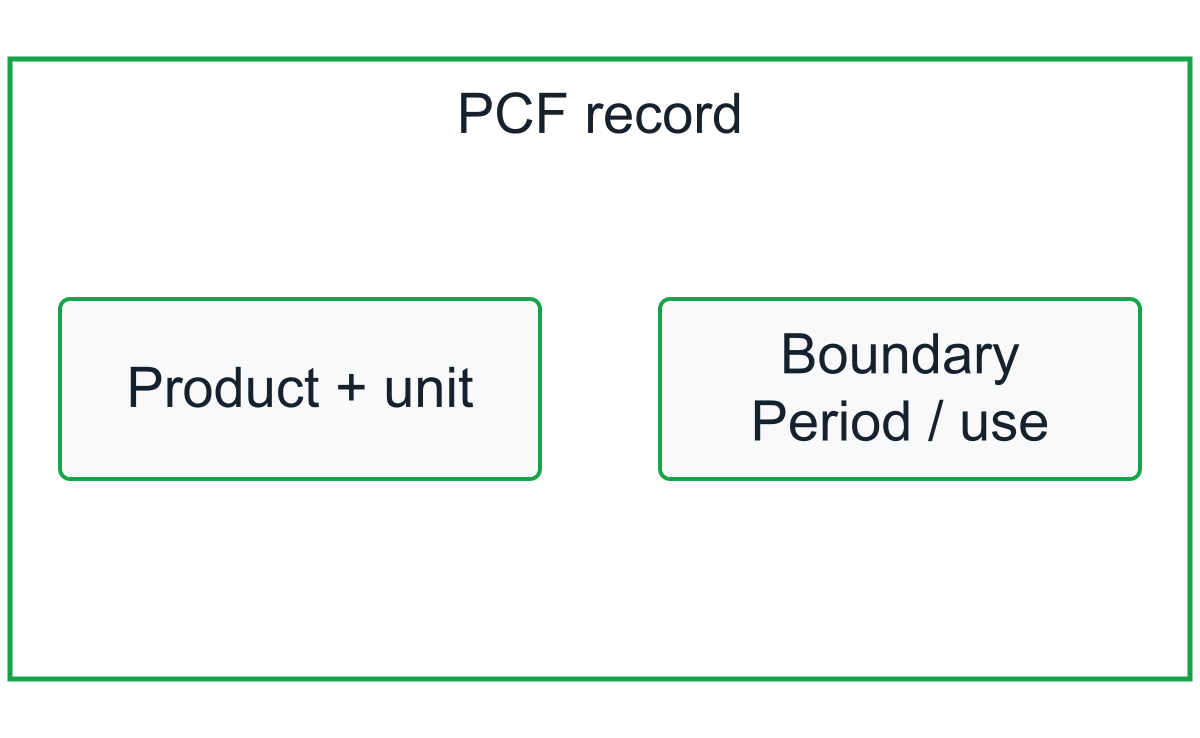
Diagram text description
These fields are an operational acceptance checklist, not a claim that every standard requires exactly the same metadata. Use the method applicable to the product and sector as the authority for calculation requirements. The handoff record tells the recipient which method was applied, which data period it describes and where the calculation evidence can be found. It prevents a precise-looking figure from becoming an orphaned number.
Why a shared number is not automatically a usable number
A buyer cannot accept a PCF just because its units match an internal spreadsheet. First match the product. The supplier's name for a component may cover multiple sizes, materials, factories or process routes. Ask whether the submitted record describes the purchased variant and whether the measurement unit can be reconciled to the purchasing unit. A footprint for a lightweight revision should not be applied automatically to an older, heavier version sold under a similar code.
Next match scope and time. A buyer estimating upstream purchased-goods emissions may need a cradle-to-gate result for the part it buys. A supplier may instead send a whole-life result including use and end of life, or a gate-to-gate plant result excluding upstream material production. Those are not interchangeable. Check the reporting period, method version, factor period and any significant changes to the process since the calculation. A source can be genuine and still be stale for the intended decision.
A matching product proceeds to the remaining use and evidence checks. A mismatched variant goes back for clarification. Passing this branch does not by itself approve the footprint, its period or a public claim.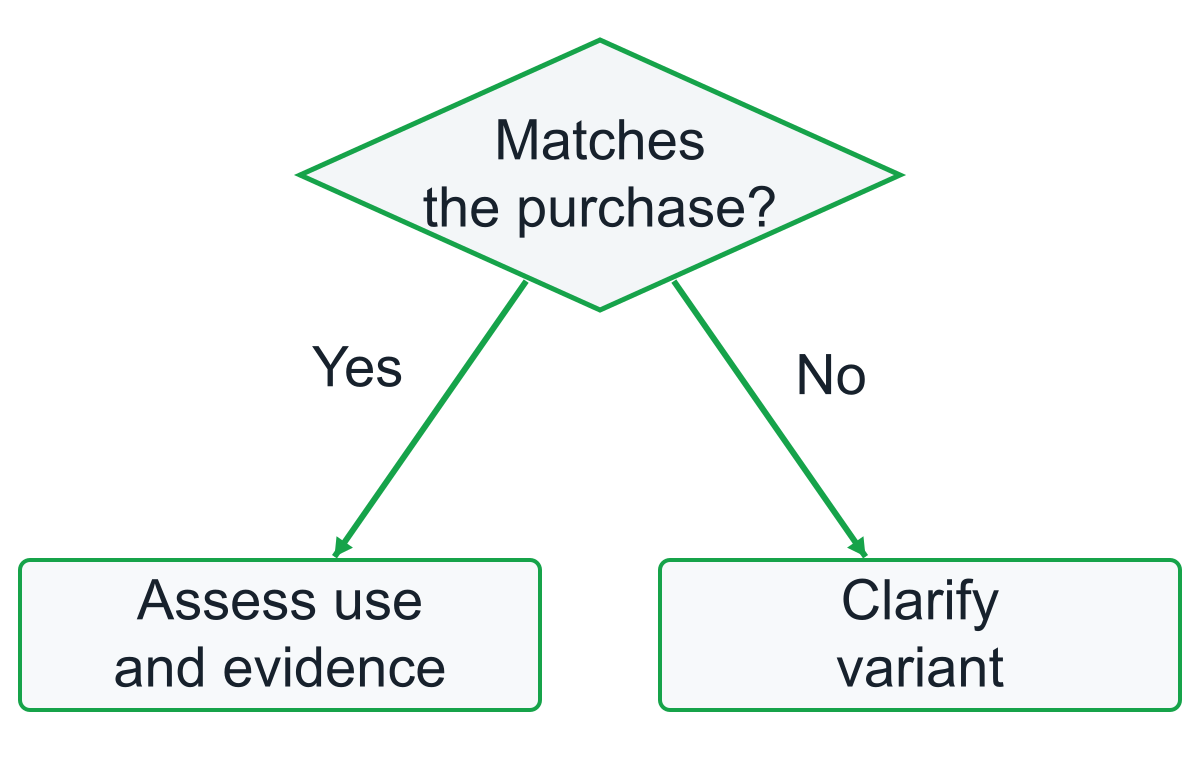
Diagram text description
Finally assess the evidence status. Does the supplier disclose the share of primary data, important assumptions, allocation approach and any independent review? Has a qualifier been attached to the result? The OECD's discussion of supply-chain footprint communication, in its agri-food context, highlights the need to transmit method and data-quality information with the number. The cross-sector lesson is to assess fitness for a specific use, not to treat all transmitted values as equally comparable. If a key field is missing, ask a question or mark the result provisional.
Calculation rules and exchange format are different controls
PACT's Methodology and its Technical Specifications answer different questions. The Methodology addresses how a product carbon footprint is calculated and what accounting conventions help make results consistent. The Technical Specifications define a data model and an API for exchanging those results between compatible software solutions. PACT's official FAQ says version 3 of the Technical Specifications was released in April 2025 and can accommodate footprints calculated under both version 2 and version 3 of the Methodology. That is a compatibility fact, not a guarantee that the source data was correct.
Think of the technical exchange as a way to preserve the fields and move them securely. Think of the methodology as part of the basis on which the footprint was derived. Neither replaces supplier governance, data-quality review or a decision about permitted use. If a company says its software is PACT conformant, check the conformant solution and the version being used; then still review the actual product record. The network page identifies conformant software and says the exchange occurs directly between partners rather than in a PACT central store.
The distinction is particularly important when a buyer ingests data automatically. An API can successfully return a well-formed PCF object whose product identifier is wrong for the purchased item, whose boundary differs from the buyer's analysis, or whose reference period predates a material process change. A successful response code is not an editorial or accounting approval. The acceptance gate belongs in the buyer's workflow.
Table 1: scroll horizontally if needed.
| Control | What it governs | What it cannot prove by itself |
|---|---|---|
| PCF methodology | Calculation boundary, data and accounting rules | That the buyer chose the correct product variant |
| Exchange specification | Record structure and secure transfer between systems | That the underlying calculation was accurate |
| Buyer acceptance | Fitness for the named purchase or reporting use | Formal third-party verification where none occurred |
Resolve the wrong variant without repeating the whole request
Imagine a buyer requesting the cradle-to-gate footprint of component B for its annual purchased-goods estimate. The order identifies revision B, but the supplier returns a complete PCF record for a similarly named component A. The message arrives intact. The identity mismatch still prevents its use as B-specific data.
Procurement checks the two codes with the supplier. If A and B are simply different catalogue names for the same supplied product, a documented mapping may resolve the exception. If B uses a different material or production route, a renamed record will not. The supplier must explain whether its submitted result represents B or provide a suitable replacement.
The request names B but the supplier initially sends A. The product owners resolve that mismatch before B is reviewed. The path is an example of exception handling; there is no arrow that automatically converts the wrong product footprint into the right one.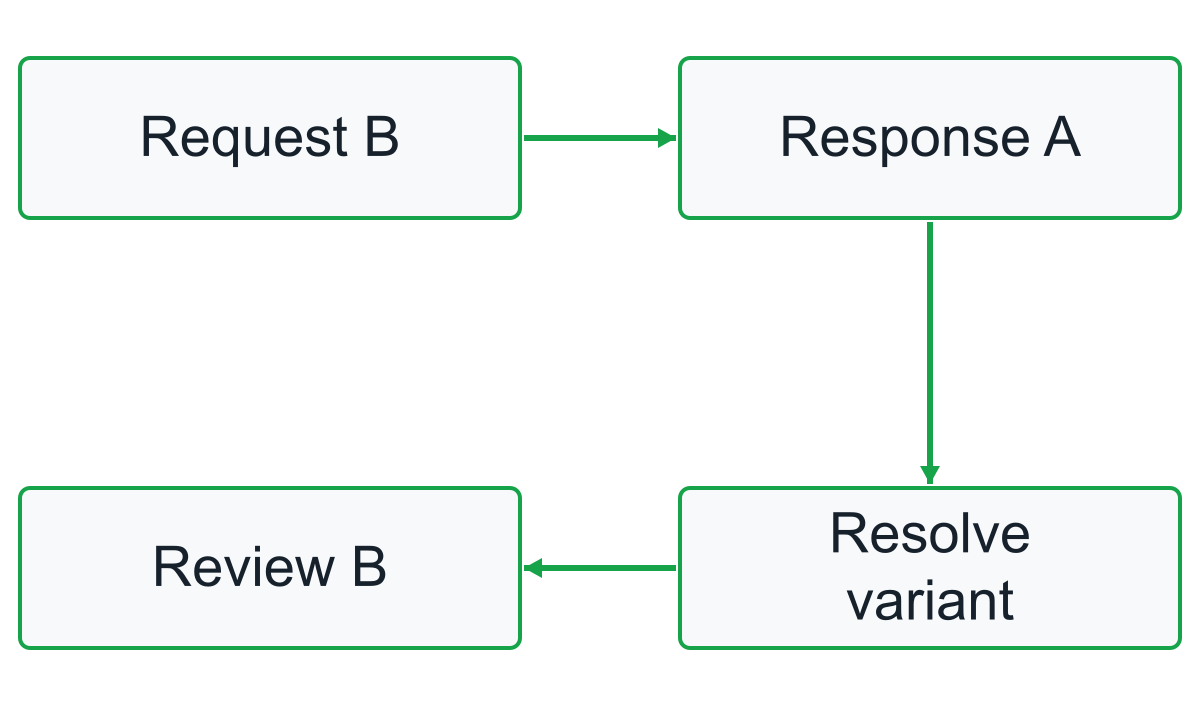
Diagram text description
Consider two physically identical parts produced at different plants. Their mass may match while electricity, process yields and upstream inputs differ. A product-code match alone does not establish that a footprint from Plant A represents the purchase from Plant B. Conversely, a supplier may have calculated a disclosed production-weighted result across plants. In that case the buyer needs to understand that averaging basis rather than demand a fictitious plant-specific figure.
Table 2: scroll horizontally if needed.
| Supplier clarification | Consequence for the buyer |
|---|---|
| Two codes identify the same product and covered production | Retain the mapping with the received record |
| Different material or manufacturing route | Request a representative result or identify a proxy |
| Disclosed multi-plant average | Assess whether its production coverage fits the purchase |
| Production coverage remains unknown | Keep the supplier-specific calculation use unresolved |
The distinction matters when procurement changes sourcing during the year. If the first deliveries came from one plant and later deliveries from another, applying one plant result to every order can obscure the actual mix. Split quantities where the records support it; otherwise explain the representative-data choice under the selected method. The exception is about which production the number describes, not whether the exchange system can transmit it.
Follow a correction into the decisions that used it
A supplier may revise a footprint because it corrected a factor, changed the product, used a new period or changed a boundary. Those are different events. Retain the old record and the reason for replacement so the buyer can tell what the new number means.
Consider an illustrative correction from 4.0 to 3.6 kg CO2e per component for the same product and period. For 200 components, the associated subtotal changes from 800 to 720 kg CO2e, a difference of 80 kg. If the reason is a corrected calculation input, the difference is a recalculation. It should not be presented as an 80 kg physical reduction caused by a manufacturing change.
The fictional PCF changes from 4.0 to 3.6 kg CO2e per component for the same product and period. For 200 components, the subtotal changes from 800 to 720 kg. The recorded reason is a correction, so the 80 kg difference is not claimed as a physical reduction.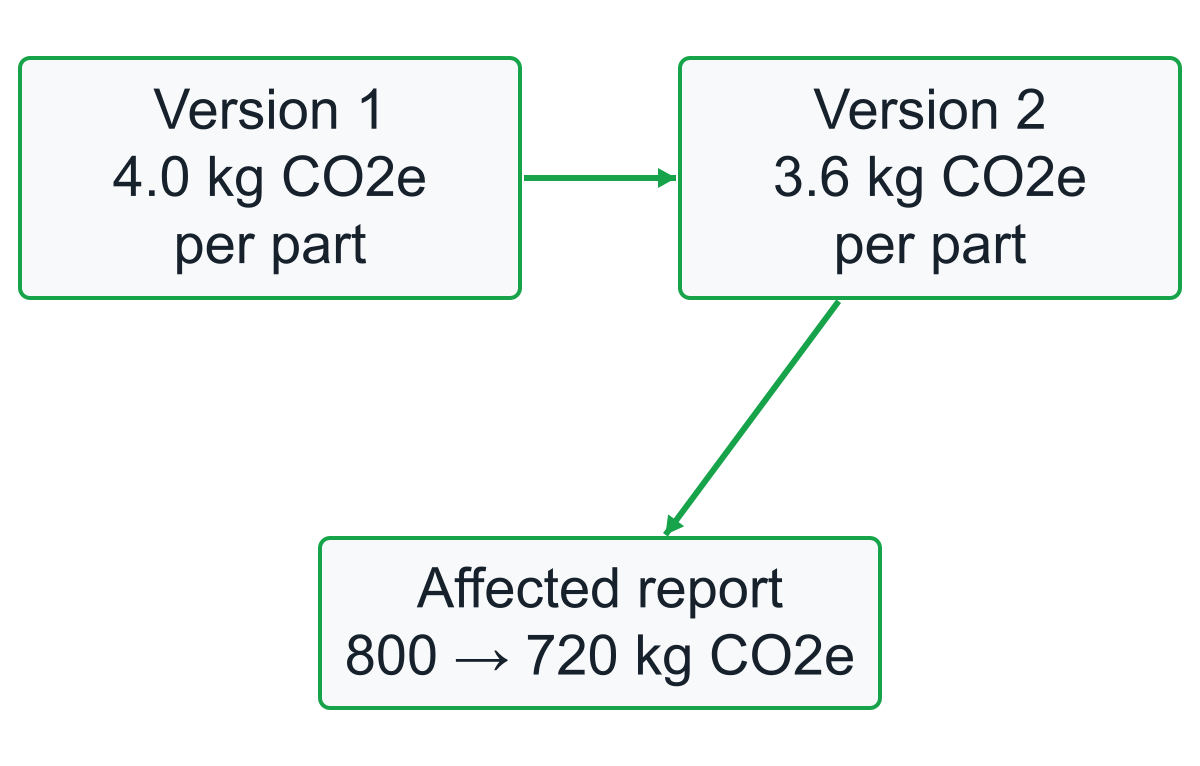
Diagram text description
That example is simple multiplication and revision arithmetic, not a new product-footprinting method. Both input PCFs are assumed to cover the same product and boundary. A change in declared unit or included stages would require another compatibility review before comparing the values.
Follow the old record's uses: the purchased-goods subtotal, an internal sourcing comparison and any customer information derived from it. The owners of those uses decide what needs updating under the applicable reporting policy. Preserve the earlier value and decision instead of replacing the number in place and leaving downstream users unaware.
The replacement notice should identify the old version and correction reason so each affected owner can distinguish recalculation from a new physical product.
Record a limited acceptance and its decision consequence
A completed decision can be short: “Revision B accepted for internal screening; the reference-period mismatch remains unresolved; procurement owns the supplier clarification.” It permits a limited use without calling the input current-year supplier-confirmed data.
Suppose two suppliers provide results from different periods. Screening can identify questions, but a small numerical difference may reflect incompatible boundaries or allocation choices rather than a purchasing advantage. Before recommending a switch, resolve the differences that could change the ranking.
The clarification has two possible consequences. Confirmation that the result still represents the relevant production may justify its continued use under the selected method. A material process change requires a new result or an explicit proxy choice. An unchanged product name does not settle that distinction.
Confidentiality creates a separate limit. Permission for internal aggregation does not necessarily permit a public supplier league table. Even an aggregate can disclose an individual result when only one supplier contributes to it. Resolve that disclosure with the data owner before publishing; technical access alone provides no answer.
Resolve a superseded identifier before changing historical uses
A supplier replaces two catalogue codes with one identifier. Determine whether this is an administrative rename, a revised physical product or a record covering several variants. Each has a different consequence for historical purchases.
For a rename, retain the mapping and effective date so old orders remain traceable. For a physical revision, keep the before-and-after purchase populations separate. Pointing every old order to the latest code can silently apply a new product's footprint to earlier deliveries.
An illustrative ledger contains 120 components under the old code and 80 under the new. A confirmed rename may leave one compatible population of 200 items. If the new code introduces another material, its footprint cannot automatically describe the first 120. Purchasing establishes quantities and timing; the supplier establishes what changed.
Route the consequences to the affected use. An internal subtotal needs a mapping or recalculation decision. A customer claim about the old physical revision must retain that identity. Updating every downstream value indiscriminately can create an error where only an identifier correction was needed.
Example: resolve the variant before converting the unit
Suppose a buyer orders 200 metal components of variant B, each weighing 0.5 kg. The supplier initially sends a PCF for heavier variant A made at a different plant. Even a correct conversion from components to kilograms would not turn A's result into a footprint for B. Product and production-route compatibility come first.
Now assume the supplier supplies an appropriate, explicitly illustrative PCF for B of 4 kg CO2e per component. The purchased subtotal is 200 × 4 = 800 kg CO2e. The same 200 components weigh 100 kg. Expressing the assumed PCF per kilogram gives 4 ÷ 0.5 = 8 kg CO2e/kg product, so 100 × 8 produces the same 800 kg result.
For the assumed compatible B component, 200 parts at 0.5 kg each are 100 kg. A PCF of 4 kg CO2e per part equals 8 kg CO2e per kg product. Both routes yield 800 kg CO2e. The conversion cannot repair a mismatched variant or boundary.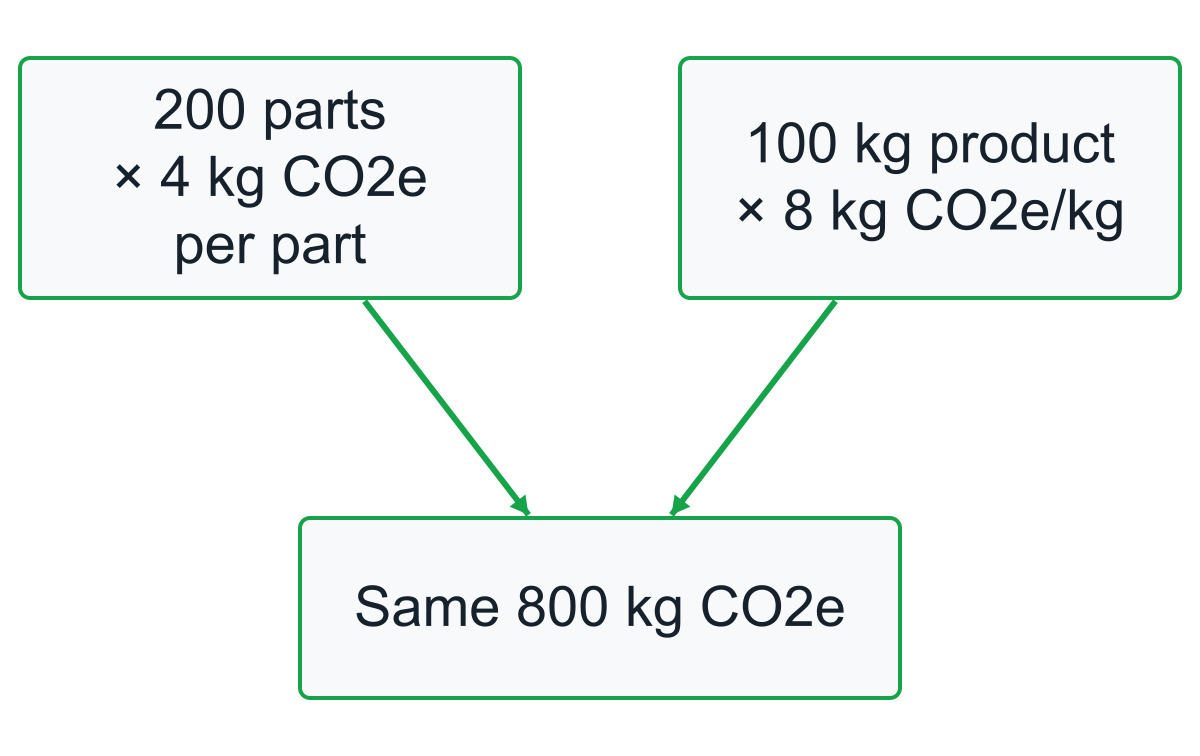
Diagram text description
Table 3: scroll horizontally if needed.
| Route | Quantity | Matching rate | Subtotal |
|---|---|---|---|
| Per component | 200 components | 4 kg CO2e/component | 800 kg CO2e |
| Per mass | 100 kg product | 8 kg CO2e/kg product | 800 kg CO2e |
This is dimensional conversion of an assumed compatible PCF, not a calculation of that PCF from life-cycle inventory data. It assumes the stated component mass and the same included product, packaging and production boundary. Using the value 4 as though it were a per-kilogram factor would halve the answer to 400 kg without changing the underlying purchase.
If the component weight varies, use a justified quantity relationship for the actual supplied population rather than a convenient nominal value. If the buyer's model expects material-only mass while the PCF includes accessories or packaging, resolve the boundary before conversion. A mathematically correct ratio cannot repair an incompatible service or product definition.
The original mismatch remains instructive: if no B-specific result exists, the buyer may need a documented proxy under its chosen method. Keep the proxy status visible. Do not rename A's record as B or describe an assumption as supplier-confirmed data.
Proceed only as far as the resolved evidence allows
A usable exchange ends with a bounded decision, not an unexplained green status. A matching record may support the intended calculation immediately. A period mismatch may permit a labelled internal estimate while a clarification remains open. An unresolved product or production-route mismatch prevents treating the number as supplier-specific evidence for that purchase.
The practical stopping point is the first unanswered question that could change the decision. If the purchase cannot be matched, resolve identity before converting units. If the result can support screening but not a public comparison, keep that distinction in the output. Reusing data is valuable only while its product meaning and permitted use remain intact.
SKU, BOM & supplier data