
Best carbon offsetting programs: a buyer’s evidence-based shortlist
A person sits at a desk holding a paper dossier with a forest photograph. A laptop and other project documents are nearby.
Diagram text description
The best carbon offsetting programme for a buyer depends on what the company intends to say, which credit types fit that purpose and whether the offered units can be verified. Write the intended use first. Screen the programme and credit category, then open the project dossier and check the units. Trace ownership and exclusive retirement before clearing any proposed public wording. A promising programme name starts a review, while the actual decision concerns the evidence behind a specific offer.
A seller can put several projects under one label, and two buyers can have different needs. A company with a policy for durable removals might screen out an avoidance offer even when the activity has a credible quantification method. A buyer with a delivery deadline may be able to compare issued units today but must handle a forward commitment as a separate commercial risk. Where an essential fact is missing, a conditional shortlist is more useful than a ranking.
The two fictional offers below show how that decision works. Both face the same questions. One remains on hold for evidence. The other fails a registry check for the offered lot.
Know what you are comparing
Compare like with like. A carbon-crediting programme sets the rules. A registry tracks units and their status under those rules. A provider may offer units that someone else developed and issued. To assess a purchase, identify each organisation's role and the exact unit or lot covered by the offer.
| What you are looking at | Role | Evidence to request |
|---|---|---|
| Crediting programme | Defines rules for activities and credit issuance | Governing documents, approved methodology and applicable version |
| Developer | Runs the activity and supplies project records | Project ID, monitoring reports and responsibility for follow-up |
| Provider or broker | Offers the units or arranges delivery | Seller authority, allocation of the offered lot and written delivery terms |
| Registry | Records issuance, holding, transfers and retirement | Public or verifiable registry records tied to the serial range |
| Issued credit | Identifies a quantified unit under the applicable rules | Serial, project, vintage, owner or authority and usable status |
Table 1, shown one row at a time. Every field is retained.
Row 1
- What you are looking at
- Crediting programme
- Role
- Defines rules for activities and credit issuance
- Evidence to request
- Governing documents, approved methodology and applicable version
Row 2
- What you are looking at
- Developer
- Role
- Runs the activity and supplies project records
- Evidence to request
- Project ID, monitoring reports and responsibility for follow-up
Row 3
- What you are looking at
- Provider or broker
- Role
- Offers the units or arranges delivery
- Evidence to request
- Seller authority, allocation of the offered lot and written delivery terms
Row 4
- What you are looking at
- Registry
- Role
- Records issuance, holding, transfers and retirement
- Evidence to request
- Public or verifiable registry records tied to the serial range
Row 5
- What you are looking at
- Issued credit
- Role
- Identifies a quantified unit under the applicable rules
- Evidence to request
- Serial, project, vintage, owner or authority and usable status
An offer may show a seller's brand, a developer name and a programme mark on the same page. Ask the seller to map each name to the registry project and identify the account or authority that can deliver the units. The buyer can retire them through its own account or instruct an authorised party, depending on the registry and contract. The route should be clear before the offer moves forward.
Set the claim and procurement brief first
Start with a short procurement brief. Define the intended use and draft the wording the business wants reviewed. Record the activity type, geography, durability requirement, delivery period and any approval constraints. A claim about supporting mitigation can lead to different evidence questions from a promise about neutralising a specified quantity of emissions. Leave the final language open until the claim has been reviewed in its intended context.
Set the eligibility gates before looking at price. A policy might require removals and evidence of storage duration, with geographic or sector limits where the buyer has a specific purpose. Decide whether the purchase needs issued units by a deadline or can include a future delivery agreement. A buyer who must retire by year-end needs a delivery and retirement path with enough time to resolve missing serials or reject substitutions.
The resulting shortlist is a set of possible credit categories. It still needs project and unit evidence. Record which conditions a supplier can satisfy and which require a different offer. If the policy is unclear, send the unresolved decision to its owner before comparing bids. Otherwise a cheap or familiar offer can silently redefine what the company meant to buy.
Use integrity thresholds, not a logo alone
Use several integrity checks together. The ICVCM Core Carbon Principles organise questions about programme governance, tracking, transparency, independent scrutiny, credited impact and safeguards. A buyer can use these dimensions to request documents and decide which gaps stop an offer. The purchase review also needs evidence specific to the actual project and units.
- Governance and transparency. Ask which programme and rule versions apply and where the decisions can be inspected.
- Tracking. Match project and unit IDs to a registry record with issuance, status and holding or retirement information.
- Quantification and independent checks. Read the methodology and verification scope for the credited period. Check whether the evidence supports the claimed quantity.
- Safeguards. Request project-level consultation, monitoring and grievance evidence, with open incidents identified.
- Counting. Ask how the programme and registry address duplicate issuance and use. Keep the buyer's proposed claim and any double-claiming questions in a separate review.
Treat a missing record according to its consequence. An evidence link the seller can supply may justify a hold. A serial list showing that the offered units are already retired can fail the offered lot. A badge may tell you what to investigate, while a shortlist decision needs the supporting record behind each required condition.
Check both programme and credit category
Programme eligibility, category approval and the offered unit are separate checks. The ICVCM assesses programmes for eligibility and credit categories for approval. Under that approach, an eligible programme can label credits from approved categories where the relevant criteria apply. An eligible programme name does not extend a category decision to every methodology, project or vintage it has issued.
Start with the exact programme and the category or methodology of the proposed units. Check the methodology version, applicability conditions and any relevant vintage or issuance limits. Compare the publisher's assessment scope to the registry and the project dossier. Where the seller presents a label, ask where it appears on the units and how the seller reconciled the methodology and scope to the assessment.
Two checks converge on the offered credit. Confirm the relevant programme and check whether the approved category and its conditions cover the methodology and unit. Then open the project dossier and verify the offered unit’s scope and registry status.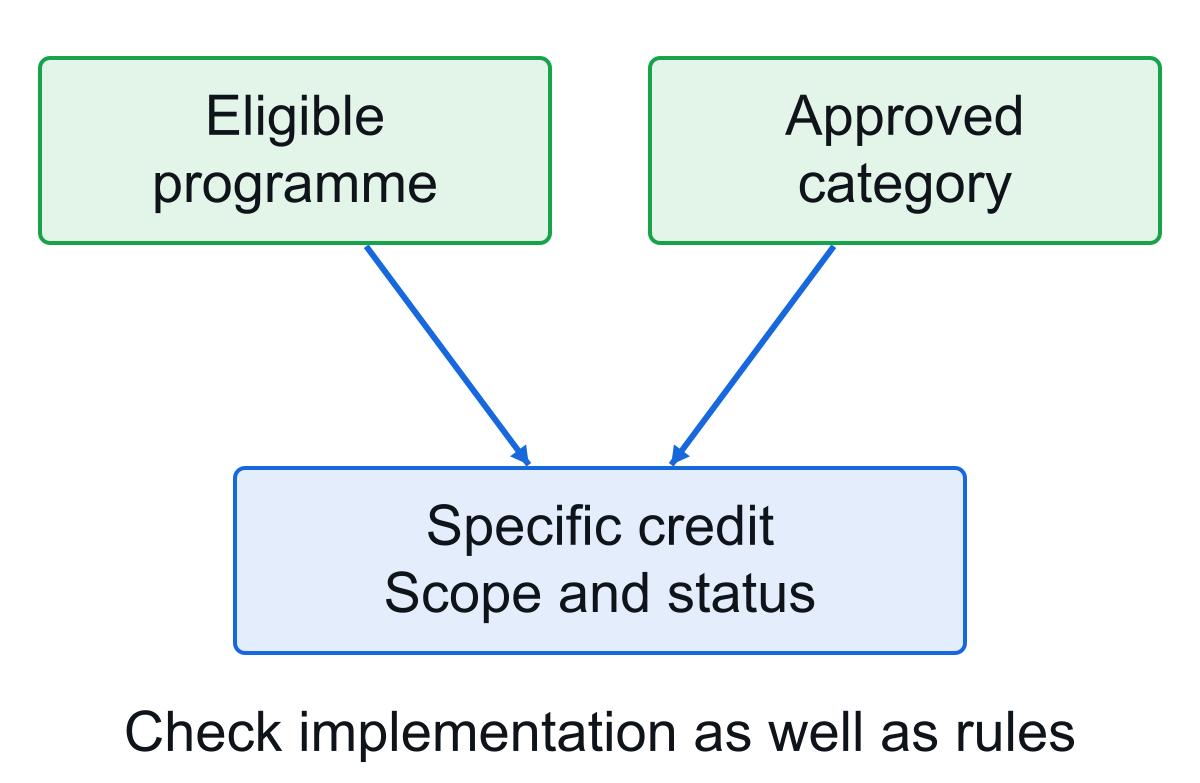
Diagram text description
Imagine a programme with two activities, only one of which falls within the relevant approved category. A brochure can describe the programme accurately while leaving the offered units outside that category. Ask for the actual lot first and look for evidence that the rules apply to it. Then check project implementation, monitoring and the status of those serials. The programme and category checks support a decision about rules. The project and registry evidence supports a decision about what the buyer would actually receive.
Ask whether the climate outcome is additional and measured
Additionality asks whether the mitigation activity goes beyond a credible account of what would otherwise have happened. Quantification asks how many tonnes the applicable method can support. A buyer needs evidence for both. A plausible baseline and incentive rationale do not by themselves show that every tonne in a monitoring report was calculated conservatively.
For example, a biochar dossier may describe the previous use of its feedstock and explain what made the new project possible. Read those baseline and incentive assumptions against the actual site and time period. Then look at the quantity record. It should show the mass and properties of the material, the applicable storage and loss assumptions, project emissions and any deductions under the method. Ask which of those inputs were measured and what the verifier checked.
Match the independent report to the project ID, methodology version, monitoring interval and quantity or issuance batch it covers. A validation document can address design while leaving the later performance period outside its scope. A verification statement for a different period does not clear the lot being offered. If a material assumption or measurement is still open, record what would change the decision. Keep the review grounded in the actual credited quantity instead of using a seller's precise price or tonnage as a proxy for confidence.
Match durability and reversal risk to the claim
Durability asks how long the climate outcome is expected to persist under the applicable method. The procurement brief should define what duration and evidence fit the intended use. Ask how the project monitors its outcome and how the programme and contract deal with losses over time.
Reversal means that previously stored carbon is released. Leakage means emissions increase outside the project boundary because the activity shifts behaviour or production elsewhere. They have different evidence needs. A land-based project can lose stored carbon after a fire or land-use change. A project can also shift harvesting to another location, which is a leakage question. The methodology should explain how each applicable risk was assessed and reflected in the credits.
For a removal involving mineral storage, inspect the measured conversion, monitoring and conditions that support the durability estimate. For biochar, check feedstock, end use and how the method treats decay and storage. An avoidance activity has a different outcome and needs a credible baseline and monitoring of displacement. Category names alone give little assurance about the actual project.
Read any buffer, insurance or replacement arrangement for its trigger, responsible party, coverage period and limits. A buyer can then tell what would happen if the original evidence changes or the project reports a loss. If the remedy leaves a material gap against the buyer's policy, retain that gap in the comparison.
Verify ownership and retirement
Start with the registry identity of the issued units. Confirm the project, vintage and serial range, and check the status of the specific units. Ask who currently holds them or has authority to transfer them. A contract can promise delivery, while a registry or independently verifiable record shows what is actually held and what happened next.
Follow one illustrative serial, DEMO-01. Issuance gives it a unique record and an initial holder. A transfer changes the holder and preserves the serial. Retirement records its use under the registry's rules. Check the retirement reference, units, date and named beneficiary or purpose against the agreed instructions. If the seller retires on the buyer's behalf, agree how the buyer can verify that link.
DEMO-01 is a fictional serial. Issuance creates the unit record and the registry shows its holder. A transfer changes the holder while keeping the same serial. Retirement records the unit’s use and links it to a retirement reference and beneficiary.
Diagram text description
A provider may send a branded certificate before the registry can show a retirement, or use a summary certificate covering a larger batch. Ask for the underlying record and match its quantity and serial range to the allocation. If the reference leads to a unit already retired for another party, reject that unit from the offer and ask for a separately reviewable replacement only if the contract allows it. A completed retirement answers the unit-use question. The claims reviewer still needs the final wording, audience and evidence for what it communicates.
Check environmental and social safeguards
Evaluate safeguards at project level. Ask what impacts were identified, who was consulted and how the project monitored the conditions or commitments it made. A description of potential community benefits can direct you to the relevant files. The decision depends on the actual project record and the way unresolved harm is handled.
- Consultation. Request the stakeholder scope, timing, key issues raised and how the project addressed them.
- Monitoring. Ask for indicators, results, responsible parties and the most recent report for the offered project.
- Grievance access. Check how people can raise issues and how responses and appeals are recorded.
- Incidents. Ask for open complaints or adverse findings, remedies, owners and deadlines, using a suitable summary if sensitive details need protection.
Compare these records to the project dossier and the verification scope. For example, a general assurance statement may cover credited tonnes while the consultation record raises a separate unresolved issue. Record both. Where a safeguard is still under investigation, ask what the provider can substantiate and which decision must remain on hold. A supplier that provides a dated response and identifies the next evidence can be compared fairly with one that gives a broad sustainability claim and leaves its project practices unknown.
Compare candidates with the same questions
Both offers in this comparison are explicitly fictional. The buyer wants 120 issued removal credits for an external mitigation contribution, with retirement for the named beneficiary by the end of its reporting period. It asks for supported storage duration, project safeguards and a traceable retirement record. Offer A presents a biochar lot. Offer B presents a mineralisation lot. All project codes, quantities and document states below are invented.
| Buyer test | Offer A, project A-17 | Offer B, project B-42 |
|---|---|---|
| Claim fit and delivery | Offers 120 issued removal units. Provider proposes buyer-beneficiary retirement before the deadline. | Offers 120 removal units and promises immediate retirement. |
| Programme and category | Dossier names the programme and biochar method version 2. No decision reference yet ties that version and vintage to the claimed category scope. | Dossier supplies programme, method version and a category decision reference. Scope still needs reconciliation to the actual units. |
| Project and quantity | Monitoring covers January to December 2024. Registry shows a project batch of 400 issued units. The verifier's schedule for that batch is missing. | Verification and issuance records are supplied for the offered batch. They describe the project output rather than proving that the seller can deliver it. |
| Durability, reversal and leakage | End-use summary supplied. Loss assumptions, monitoring and replacement limits still need support. | Monitoring plan and durability basis supplied. Buyer has yet to confirm the remedy limits and leakage treatment. |
| Ownership and retirement | Seller identifies the 400-unit issuance, but no allocation identifies which 120 would be delivered. Retirement terms are provisional. | The exact 120 offered serials are already retired for a different beneficiary in the fictional registry. |
| Safeguards | Consultation summary supplied. An open haulage complaint has no dated response or owner in the dossier. | Incident log supplied with no open entry for the credited period. The scope of the log still needs checking. |
| Decision | Hold for category, verification, durability, serial allocation, retirement and safeguards evidence. | Reject this lot because the units are already retired for another beneficiary. |
Table 2, shown one row at a time. Every field is retained.
Row 1
- Buyer test
- Claim fit and delivery
- Offer A, project A-17
- Offers 120 issued removal units. Provider proposes buyer-beneficiary retirement before the deadline.
- Offer B, project B-42
- Offers 120 removal units and promises immediate retirement.
Row 2
- Buyer test
- Programme and category
- Offer A, project A-17
- Dossier names the programme and biochar method version 2. No decision reference yet ties that version and vintage to the claimed category scope.
- Offer B, project B-42
- Dossier supplies programme, method version and a category decision reference. Scope still needs reconciliation to the actual units.
Row 3
- Buyer test
- Project and quantity
- Offer A, project A-17
- Monitoring covers January to December 2024. Registry shows a project batch of 400 issued units. The verifier's schedule for that batch is missing.
- Offer B, project B-42
- Verification and issuance records are supplied for the offered batch. They describe the project output rather than proving that the seller can deliver it.
Row 4
- Buyer test
- Durability, reversal and leakage
- Offer A, project A-17
- End-use summary supplied. Loss assumptions, monitoring and replacement limits still need support.
- Offer B, project B-42
- Monitoring plan and durability basis supplied. Buyer has yet to confirm the remedy limits and leakage treatment.
Row 5
- Buyer test
- Ownership and retirement
- Offer A, project A-17
- Seller identifies the 400-unit issuance, but no allocation identifies which 120 would be delivered. Retirement terms are provisional.
- Offer B, project B-42
- The exact 120 offered serials are already retired for a different beneficiary in the fictional registry.
Row 6
- Buyer test
- Safeguards
- Offer A, project A-17
- Consultation summary supplied. An open haulage complaint has no dated response or owner in the dossier.
- Offer B, project B-42
- Incident log supplied with no open entry for the credited period. The scope of the log still needs checking.
Row 7
- Buyer test
- Decision
- Offer A, project A-17
- Hold for category, verification, durability, serial allocation, retirement and safeguards evidence.
- Offer B, project B-42
- Reject this lot because the units are already retired for another beneficiary.
The registry shows why B's marketing promise cannot be used for these units. Its verification record addresses the underlying project, while the retirement record answers whether these serials are available. A remains on hold even though B is rejected. From a 400-unit issuance, the buyer needs the exact 120 eligible and available units, with no overlap and a deliverable retirement instruction. The supplier's proposal and a price comparison cannot settle those facts.
Request evidence before signing
Send the same evidence request to each shortlisted provider. Ask for one response per lot. Require a document reference, date or period where relevant and an owner for anything missing. Keep the fields below in the request, then use the last column to decide what the reply supports.
| Field in the request | Provider response needed | What lets review proceed |
|---|---|---|
| Programme, category and method | Programme and project ID, assessment reference, category, methodology version, vintage and applicable conditions | The decision and rules can be matched to the project and offered units. |
| Monitoring and verification | Monitoring start and end, validation and verification references, verifier, scope, quantity and issuance batch | The verified interval and amount reconcile to the batch in the registry. |
| Serial allocation | Full serial range or itemised list, offered quantity, vintage and issuance reference | The exact offered count reconciles and each serial appears once. |
| Ownership and transfer | Registry, current holder or delivery authority, status, transfer route and delivery deadline | Authority and availability are verifiable for the exact serials. |
| Durability, reversal and leakage | Storage basis, monitoring, risk deductions, response triggers, replacement terms and limits | The evidence and remedy meet the stated buyer policy. |
| Retirement | Responsible party, registry action, deadline, beneficiary, purpose and deliverable retirement record | The contract requires a verifiable retirement for the agreed use. |
| Safeguards and open items | Consultation, monitoring and grievance records, incidents, remedies, dates and accountable owners | Any material open item has evidence for closure or a recorded hold. |
| Contract and substitution | Reserved lot, substitutions requiring approval, failed-delivery remedy and sign-off owner | The buyer can reject different or unavailable units and preserve the reason. |
Table 3, shown one row at a time. Every field is retained.
Row 1
- Field in the request
- Programme, category and method
- Provider response needed
- Programme and project ID, assessment reference, category, methodology version, vintage and applicable conditions
- What lets review proceed
- The decision and rules can be matched to the project and offered units.
Row 2
- Field in the request
- Monitoring and verification
- Provider response needed
- Monitoring start and end, validation and verification references, verifier, scope, quantity and issuance batch
- What lets review proceed
- The verified interval and amount reconcile to the batch in the registry.
Row 3
- Field in the request
- Serial allocation
- Provider response needed
- Full serial range or itemised list, offered quantity, vintage and issuance reference
- What lets review proceed
- The exact offered count reconciles and each serial appears once.
Row 4
- Field in the request
- Ownership and transfer
- Provider response needed
- Registry, current holder or delivery authority, status, transfer route and delivery deadline
- What lets review proceed
- Authority and availability are verifiable for the exact serials.
Row 5
- Field in the request
- Durability, reversal and leakage
- Provider response needed
- Storage basis, monitoring, risk deductions, response triggers, replacement terms and limits
- What lets review proceed
- The evidence and remedy meet the stated buyer policy.
Row 6
- Field in the request
- Retirement
- Provider response needed
- Responsible party, registry action, deadline, beneficiary, purpose and deliverable retirement record
- What lets review proceed
- The contract requires a verifiable retirement for the agreed use.
Row 7
- Field in the request
- Safeguards and open items
- Provider response needed
- Consultation, monitoring and grievance records, incidents, remedies, dates and accountable owners
- What lets review proceed
- Any material open item has evidence for closure or a recorded hold.
Row 8
- Field in the request
- Contract and substitution
- Provider response needed
- Reserved lot, substitutions requiring approval, failed-delivery remedy and sign-off owner
- What lets review proceed
- The buyer can reject different or unavailable units and preserve the reason.
For A-17, request the category decision for method version 2, the verification schedule for the 2024 batch and the available 120-unit allocation. Ask for the storage and reversal evidence, the response to the complaint and a firm retirement instruction. Have the inventory or sustainability owner close the evidence questions, then have procurement check the contract and the remedy for failed delivery. Review final public wording against the completed evidence and its intended use. A new lot from either provider needs its own serial and evidence check before substitution.
Keep credits separate from emissions reduction
Keep the company's gross emissions inventory and own-emissions reductions visible alongside a separate record of credit use. The inventory reports measured or estimated emissions for the stated organisational boundary and period. An actual reduction within that boundary needs comparable activity and methodology evidence. Buying or retiring units from a separate project records an external action.
Keep a credit register with project, units, ownership, retirement and the intended use. The claims reviewer can then see the supporting retirement and the latest proposed wording without changing the gross inventory. The reviewer may need to consider the relevant claims framework, buyer policy, audience and jurisdiction. A credit-integrity label and a retirement entry answer important questions about the units, while claim wording needs its own review.
The left record holds company activity, its gross emissions inventory and evidence of changes within the measured boundary. The right record holds the external units, retirement evidence and the proposed claim. Each record supports a separate review.
Diagram text description
For the fictional buyer, a later retirement would be evidence of what happened to the allocated units. It would leave the company's measured inventory intact and would support only the use the reviewer can substantiate. Store the claim decision with its owner, evidence and date. This keeps the procurement record available when the company checks whether it can repeat or update the statement for a later period.
Read rankings with their conflicts visible
Before using a ranking, ask what it ranks and how the publisher benefits. A list of brokers answers a different question from an assessment of crediting programmes, projects or specific issued units. A seller can feature offers it sells or earns a fee from. Check for commercial relationships, the comparison date, how candidates were selected and which evidence counted toward the result.
Inspect the assumptions behind any price claim. A quoted amount can apply to a different quantity, vintage, geography or delivery date. It can omit fees for transfer or retirement. Ask which specific units and terms the price covers. When a quality claim appears, look for the original assessment or registry evidence and check its scope. General programme status cannot tell you whether the price and availability apply to the lot you can buy.
Use a ranking to discover names or questions worth following up. If its method, commercial relationships or source dates are unclear, carry that uncertainty into the shortlist. The buyer can then use the same request across offers and judge the returned evidence under its own procurement brief. A supplier with an appealing headline may still be unable to document the actual units.
Keep the evidence with the purchase decision
Keep the purchase decision with the evidence that supports it. Use one versioned record per proposed lot and link the programme and methodology, project monitoring and verification, serial range, contract, and intended retirement. Give each unresolved question a decision owner, due date and consequence. Keep sensitive contract and stakeholder information within appropriate access controls.
Procurement can own delivery and substitution terms, the credit reviewer can reconcile project and registry evidence, and the communications reviewer can own the final wording. A single record lets those owners work from the same lot and distinguish evidence received from decisions approved. If an offer changes, keep the original proposal and document which parts of the evidence must be checked again.
When the contract is complete, attach the registry evidence for the delivered and retired units. If an unresolved safeguard or failed delivery changes the decision, record the disposition with the dated reason. Reuse the recorded scope and decision questions for a subsequent comparison, while obtaining evidence for the new lot. The value of the record is that another reviewer can see what was checked, which uncertainties remain and what the company agreed to use.
Make the shortlist, then choose a credit
Choose a credit after the procurement brief, programme and category, project evidence, and unit status line up. Use the same fields for every offer. Hold a candidate when a material fact is missing and reject a lot when its registry evidence rules out delivery. Reserve final claim wording for the separate review after the relevant evidence is available.
For the fictional shortlist, A-17 can progress only when the buyer can verify the exact units and close the method, monitoring, safeguards and retirement gaps. B-42's offered serials fail the availability test. These outcomes follow from what the buyer can establish about the offered lots.
Once the shortlist is sound, use a dedicated credit-quality review for deeper methodology questions, an issuance and retirement explanation for the unit lifecycle, and a separate calculation for quantities and reporting treatment. If timing matters, check the applicable rules and contract for use limits or expiry rather than assuming a universal shelf life. Keep those decisions attached to the same evidence file.